Aryan Pariyar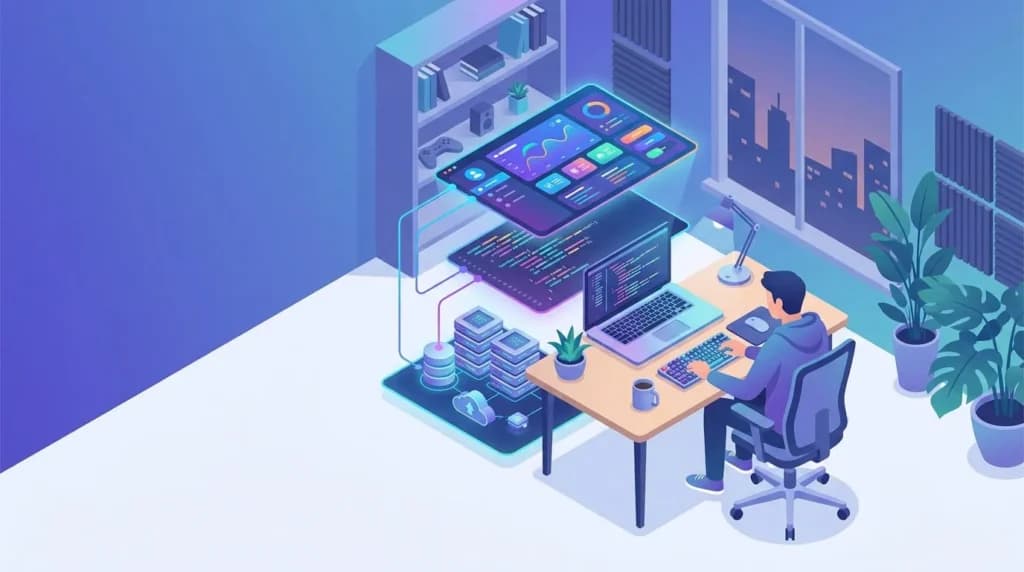
If you’ve spent any time browsing job boards or freelance marketplaces, you’ve probably noticed one phrase popping up everywhere: full-stack developer. Companies of every size, from solo founders to large enterprises, are looking for people who can take an idea, build it, ship it, and keep it running. That’s the core promise of full-stack web development, and it’s exactly why it remains one of the most in-demand skill sets in tech heading into 2026.
This guide walks you through what full-stack development actually involves, the tools and languages you’ll need, and a realistic, step-by-step path for getting started, even if you’re a complete beginner.
What Is Full-Stack Web Development?
At its simplest, full-stack web development means being comfortable working on every layer of a web application, the part users see and click on, the server logic running behind the scenes, and the database that stores and organizes everything.
A full-stack developer doesn’t necessarily master every technology equally, but they understand how all the pieces connect. That broad view is what makes them valuable: they can plan a feature, build it end to end, test it, and fix it when something breaks, without waiting on three different specialists to coordinate.
The Three Layers of Every Web Application

1. Front-End (Client Side)
This is everything a visitor interacts with directly, page layouts, navigation menus, forms, buttons, and animations. Front-end work is built primarily with HTML, CSS, and JavaScript, often combined with modern frameworks such as React, Vue, or Next.js to create fast, responsive interfaces that work well across devices.
2. Back-End (Server Side)
The back-end is the “engine room”, it handles requests from the front-end, runs business logic, manages user authentication, and talks to the database. Popular back-end choices include Node.js, Python (Django or FastAPI), PHP, and Java, along with backend-as-a-service platforms like Supabase or Firebase, which have made it much faster to spin up secure, production-ready APIs without building everything from scratch.
3. Database & Data Layer
Every application needs somewhere to store information, user accounts, orders, messages, and more. Relational databases like PostgreSQL and MySQL are ideal when data needs to stay strictly organized and consistent (think e-commerce or finance apps), while NoSQL databases like MongoDB are better suited for flexible, fast-changing data structures.
A well-rounded full-stack developer also understands the deployment layer, using tools like Git, Docker, and hosting platforms such as Vercel, Netlify, or AWS to get an application live and keep it running smoothly.
Core Skills Every Full-Stack Developer Needs
To work confidently across the stack, focus on building strength in these areas:
- Front-end fundamentals, HTML, CSS, JavaScript, and at least one modern framework (React or Vue are the most widely used)
- Back-end & API design, writing clean, secure APIs that the front-end can communicate with
- Database design, structuring data so it’s fast to query and easy to maintain
- Version control, using Git and GitHub to track changes and collaborate with others
- Deployment basics, getting projects online using cloud platforms or modern hosting services
- Problem-solving and communication, full-stack developers often act as the bridge between designers, testers, and clients, so being able to explain technical decisions clearly is just as important as writing code
Why Full-Stack Skills Are More Valuable Than Ever
Faster Development, Lower Costs
A single developer who understands the entire system can move faster than a team that constantly has to hand work back and forth between specialists. This is especially valuable for startups, small businesses, and freelance projects, where budgets and timelines are tight.
Easier Debugging
When something breaks, a full-stack developer can trace the issue from the interface all the way down to the database, without waiting for multiple teams to investigate separately.
End-to-End Ownership
Full-stack developers can take a project from idea to launch, which builds trust with clients and gives them more control over quality and consistency.
Adaptability in a Changing Market
As businesses increasingly look to add smart, AI-driven features to their products, developers who understand the full picture, front-end, back-end, data, and how AI fits into all of it, are positioned to deliver more value.
How AI Is Changing Full-Stack Development

AI has shifted from being a “nice to have” to a core part of the modern development workflow:
- AI coding assistants (built into editors and IDEs) can generate boilerplate code, suggest fixes, and speed up repetitive tasks, though developers still need to review, test, and understand everything that gets generated.
- AI-powered app builders now let developers go from idea to working prototype in hours rather than weeks, which is especially useful for testing concepts before investing in a full custom build.
- AI features inside applications, like smart search, chatbots, content generation, and personalized recommendations, are increasingly expected by users, and integrating AI APIs is becoming a standard part of a full-stack developer’s toolkit.
Understanding how to use these tools effectively, while still knowing the fundamentals well enough to catch mistakes, is quickly becoming a baseline expectation rather than a bonus skill.
Step-by-Step Roadmap: How to Become a Full-Stack Developer

Step 1: Build Your Front-End Foundation
Start with HTML, CSS, and JavaScript, these are non-negotiable. Once comfortable, move on to a framework like React or Vue to learn how modern, component-based interfaces are built.
Step 2: Learn a Back-End Language and Build APIs
Pick one back-end language (Node.js is a strong choice since it lets you stay in JavaScript) and learn how to build APIs, the connection points that let your front-end request and send data.
Step 3: Get Comfortable with Databases
Learn the basics of a relational database like PostgreSQL, including how to design tables, write queries, and connect a database to your application. Once you’re confident, explore NoSQL options to understand when they’re a better fit.
Step 4: Learn Git, Deployment, and Basic Workflow Tools
Get familiar with Git and GitHub for version control, and practice deploying a project using a platform like Vercel or Netlify. Knowing how to take a project from “running on my computer” to “live on the internet” is a major milestone.
Step 5: Build Real Projects, Not Just Tutorials
This is where everything comes together. Start small: a to-do app, a notes app, or a simple booking system. Then build something bigger, a small e-commerce site, a dashboard, or a booking platform, and deploy it so it’s publicly accessible. These projects become the core of your portfolio.
Step 6: Learn to Work With AI Tools (and Review Their Output)
Practice using AI coding assistants and AI app builders for prototyping and speeding up repetitive work, while making sure you understand what the generated code is doing. This combination, solid fundamentals plus efficient AI use, is what sets developers apart.
Step 7: Keep Learning
Web development changes constantly. Set aside time each week to follow new frameworks, read documentation, and experiment with updated tools. Curiosity and adaptability matter just as much as any single technology.
Common Mistakes Beginners Should Avoid
- Getting stuck in “tutorial hell”, watching endless courses without building anything original
- Skipping databases, many beginners focus only on the front-end and avoid data modeling, which limits the kinds of projects they can build
- Avoiding Git, version control feels unnecessary at first, but it’s essential for any real-world or collaborative project
- Never deploying anything, a project that only runs locally doesn’t demonstrate to clients or employers that you can ship working software
Career Paths for Full-Stack Developers
Full-stack skills open doors to several paths:
- Full-time roles at startups and agencies, where versatility is highly valued
- Freelancing, building websites and web apps for small businesses, often the fastest way to start earning while building a portfolio
- Remote work with international clients, since full-stack developers can independently handle most of a project without needing a large local team
- Building your own products, using the same end-to-end skills to launch personal projects or small SaaS tools
Final Thoughts
Full-stack web development isn’t about knowing everything, it’s about understanding how the pieces fit together and being capable enough across the stack to take a project from concept to a live, working product. Start with the fundamentals, build real projects, learn to use modern tools (including AI) effectively, and keep iterating.
If you’re a business owner or founder looking for a developer who can handle front-end design, back-end logic, databases, and deployment under one roof, that end-to-end approach is exactly what full-stack development offers, and it’s the kind of work I take on for clients of all sizes.
Frequently Asked Questions
1. What does a full-stack developer actually do day to day? A full-stack developer works across the entire application, building user interfaces, writing server-side logic and APIs, managing databases, and handling deployment. The exact mix depends on the project, but the goal is always the same: take a feature from idea to a working part of the product.
2. Do I need to learn every technology to be a full-stack developer? No. Most full-stack developers specialize a bit more in either front-end or back-end while staying comfortable enough with the rest of the stack to build complete projects independently.
3. What’s the difference between front-end and back-end development? Front-end development focuses on what users see and interact with, layout, design, and interactivity. Back-end development handles the logic behind the scenes, processing data, managing databases, and securing user information.
4. Which programming language should I learn first? JavaScript is a strong starting point because it’s used on both the front-end and back-end, which means you can build complete applications with just one language while you’re learning.
5. Is full-stack development a good career choice in 2026? Yes. As businesses continue to prioritize fast, cost-effective development, and increasingly want AI features built into their products, developers who can work across the full stack remain highly sought after, both for full-time roles and freelance work.

Aryan Pariyar
Web developer in Nepal, working with global companies across the Netherlands, UK and Australia. 100+ websites shipped, AI ad creatives generating thousands of sales, and 1,000+ students trained.
More about me →Have a project in mind?
Let's turn your idea into something premium.

Let's build it together!
Contact NowNot sure where to start?
Tell me about your project and I'll get back within 24 hours.