Aryan Pariyar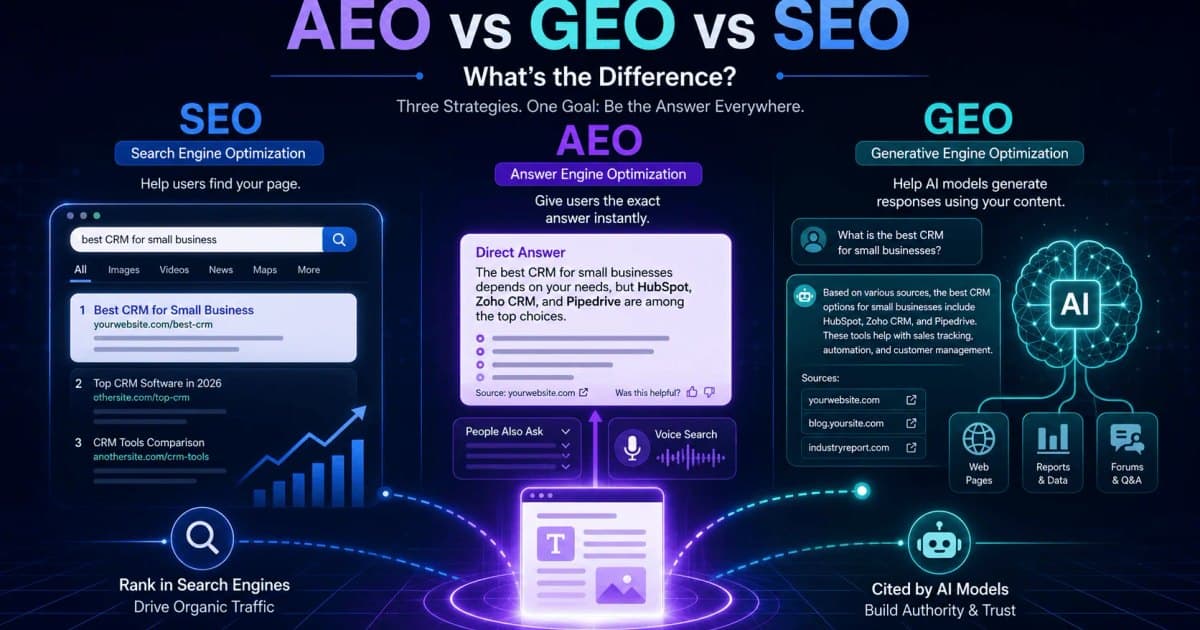
Quick answer: SEO gets your page ranked in Google so people click it. AEO (answer engine optimization) gets your content lifted out as the direct answer, featured snippets, People Also Ask, voice results. GEO (generative engine optimization) gets your brand cited inside AI-generated answers from ChatGPT, Gemini, Perplexity and Google's AI Overviews. Three strategies, one goal: be the answer wherever your customer asks the question.
Most articles on this topic stop at definitions. This one goes further: I recently rebuilt this very website's SEO, AEO and GEO layer after an audit scored it 64/100, and below you'll find the exact checklist I applied, with the tools, the schema, and the file most websites in Nepal don't even know exists. I'm Aryan Pariyar, a web developer and technical SEO specialist in Nepal; everything here is what I do for client sites too.
Why this matters right now (with numbers)
Search didn't stop being search, it grew extra mouths. Google's AI Overviews now appear for a large share of queries and, per Google, reach well over a billion users monthly. ChatGPT added live web search with cited sources; Perplexity was built on citations from day one. And Google's own guidance on AI features is blunt: its generative results are rooted in core Search ranking, no special tricks, just genuinely helpful, well-structured content.
The research is equally clear about what gets cited. A Princeton/Georgia Tech study on generative engine optimization found that adding citations, statistics and quotations to content boosted its visibility in AI answers by roughly 30 to 40%, while keyword stuffing actually reduced it. In other words: the things that make content trustworthy to humans are the things AI engines select.
SEO, AEO, GEO and SXO, side by side
| SEO | AEO | GEO | SXO | |
|---|---|---|---|---|
| Goal | Rank the page, earn the click | Be the direct answer | Be cited in AI answers | Turn the visit into action |
| Where you appear | Google/Bing results list | Featured snippets, People Also Ask, voice assistants, AI Overviews | ChatGPT, Gemini, Perplexity, Copilot, Claude | Your own page, after the click |
| What it rewards | Relevance, authority, speed, links | Concise answers, question headings, structured data | Extractable passages, cited sources, named expertise, brand consistency | The answer up top, a clear next step, pages that work on a phone |
| Key content pattern | Comprehensive page on a topic | 40 to 60 word answer right under a question heading | Tables, lists, statistics with sources, FAQs | Price or answer first, one obvious call to action |
| Technical layer | Core Web Vitals, crawlability, sitemaps | FAQPage / HowTo schema, clean headings | AI crawlers allowed in robots.txt, llms.txt, Organization/Person schema | Mobile layout, speed, forms that behave |
| How to measure | Search Console rankings and clicks | Snippet/PAA appearances | Manual AI checks, AI-referral traffic, visibility tools | GA4 engagement and enquiries per visit |
Notice the pattern down each column: the layers stack. AEO is SEO with structure; GEO is AEO with proof and permissions. Do them in order and each one makes the next nearly free. SXO sits across all three: it's what decides whether the traffic they earn turns into customers.
SEO: the foundation nobody gets to skip
Search engine optimization is still the discipline of being the best result for a query: content that fully answers the intent, a site Google can crawl quickly, technical health, and authority earned from other sites. In 2026 its technical half matters more, not less, Google's AI features summarize pages that already rank, and page experience signals like Core Web Vitals decide who's in that pool. If your site is slow, nothing downstream works; check yours with my free Website Speed Checker, and see what's typically wrong in why websites in Nepal are slow.
AEO: becoming the answer, not just a result
Answer engine optimization exists because a growing share of searches end without a click, the answer appears on the results page, or is spoken by an assistant. You win those by making the answer trivially easy to lift: a question-style heading, a direct 40 to 60 word answer immediately below it, then the detail. Add FAQ sections marked up with FAQPage schema, use tables for comparisons and numbered lists for processes. Every guide on my free tools pages opens this way, and this article does too, scroll up: the first paragraph is the snippet.
GEO: getting cited by ChatGPT, Gemini and Perplexity
Generative engine optimization is the newest layer, and the one with the most nonsense written about it. What actually works, per the research and Google's own guidance: extractable structure (AI systems quote passages, not pages), evidence (statistics and sources it can verify), named expertise (a real author with credentials, E-E-A-T), freshness (visible dates), and consistency, the same business name, description and details across your site, Google Business Profile, LinkedIn and directories, because AI models cross-check entities. Two technical pieces close the loop: allowing AI crawlers in robots.txt, and an llms.txt file that hands AI systems a clean summary of your site.
One honest caveat: Google says explicitly that no special markup or AI-specific files are required for AI Overviews, write for people, structure for clarity, and you're covered there. The extra GEO steps matter for the other engines (ChatGPT, Perplexity, Claude) and for autonomous AI agents that increasingly research and recommend businesses on users' behalf.
SXO: what happens after the click
Search experience optimization is the part most SEO skips. Ranking, answering and being cited all end the same way: someone lands on your page. SXO asks whether that page gives them what they searched for, quickly, on the phone in their hand, with an obvious next step. A page that ranks first and loses the visitor in five seconds has done half the job.
On this site, the SXO fixes were small and specific:
- Answer the search that brought them. Most searches here were about price, and the service pages said "contact for quote". They now show real starting prices.
- Put the offer where the intent is. Readers of a cost guide now finish on the matching service and its packages, instead of a generic "let's talk".
- Make it work on a phone. Wide tables had pushed whole articles sideways on mobile. They now scroll inside their own box.
- Let forms say what went wrong. Form errors showed in the same green as success messages. They're red now.
- Make menus usable for everyone. The dropdowns only opened on mouse hover. They now open with a keyboard too, and search engines can see their links.
Measure SXO in GA4, not rankings: engaged sessions, how far people scroll, and above all how many visits turn into an enquiry.
Where ASO fits: app stores are search engines too
App store optimization is SEO for the Google Play Store and the Apple App Store. I'm publishing my own Android apps, so this is what I've learned so far, not a service pitch. The core idea carries over: the right words in the right fields, and a listing convincing enough to install. But the fields are small and fixed:
| Field | Google Play | Apple App Store |
|---|---|---|
| App name | 30 characters | 30 characters |
| Short line under the name | Short description, 80 characters | Subtitle, 30 characters |
| Hidden keywords | None | Keyword field, 100 characters |
| Full description | 4,000 characters, and it's searched | 4,000 characters, not searched |
That last row is the big difference. On Apple, the keywords you rank for live in the name, subtitle and hidden keyword field. On Google Play there's no keyword field, so your description does that job, written for people but with the phrases they actually search. The limits come from Google's Play Console guidance and Apple's App Store Connect.
Two lessons from my own listings. First, consistency matters in app stores too: my first listing used a different contact number from my website, the same entity mismatch GEO punishes. Second, new personal Google Play accounts must run a closed test with 12 testers for 14 days before release, so plan launch dates around it. I've covered that and the rest of the costs in my guide to mobile app development cost in Nepal.
Case study: what I changed on this website
An SEO/AEO/GEO audit of this site's homepage scored it 64/100, SEO 77, AEO 60, GEO 55. The site ranked, but wasn't structured to be quoted. Here's what I changed, in the order I'd do it for any client:
| Audit finding | What I did | Layer |
|---|---|---|
| No summary answer near the top | Added a "Key takeaway" block: one-paragraph direct answer, who it's for, use cases | AEO / GEO |
| No published/updated date | Visible dates on the page + dateModified in schema | GEO |
| No credible external citations | Cited Google's Core Web Vitals docs and other sources inline | GEO |
| FAQ answers hidden until clicked | Answers rendered in the HTML under <h3> questions, FAQPage schema | AEO |
| Missing Article/Breadcrumb schema | ProfilePage + BreadcrumbList linked to Person and Organization | SEO / GEO |
| Site name showing as bare domain in Google | WebSite schema with name + alternateName, matching og:site_name and title | SEO |
| No AI-readable site summary | Published llms.txt, llms-full.txt and pricing.md; allowed 20 AI crawlers in robots.txt | GEO |
| Mobile speed score in the 70s | Removed render-blocking animation, cut fonts to three Latin files, cheaper paint, LCP now paints in the first frame | SEO |
None of this required new content, it required structuring existing content so machines could quote it and verify it. That's the whole insight: SEO, AEO and GEO are mostly the same work, done properly once.
Update, 26 September 2026: here's what Google Search Console shows since these changes and the guides that followed. Impressions went from about 2 a day in July to 44 a day in September, and clicks from 2 in July to 34 in the first 23 days of September. AI citation data is still too early to report honestly, so I'll add it when there's enough to mean something. The full list of what I checked and fixed is in my SEO audit checklist.
The 12-point checklist for any website
- Fix speed first, 90+ mobile score, Core Web Vitals green (test it free).
- One unique title and description per page, keyword early, brand at the end (meta tag generator).
- Open every important page with a direct answer, 40 to 60 words, no throat-clearing.
- Use question headings that match how people ask, with the answer immediately below.
- Add tables and numbered lists for comparisons and processes, AI engines love structure.
- Cite sources and include statistics with dates; link to the original research, not summaries.
- Show a real author with credentials and an About page; add Person/Organization schema.
- Add FAQ sections with FAQPage schema, visible answers, not click-to-reveal only.
- Allow AI crawlers (GPTBot, OAI-SearchBot, PerplexityBot, ClaudeBot, Google-Extended) in robots.txt and publish llms.txt.
- Be consistent everywhere, same name, description and details on your site, Google Business Profile, LinkedIn and directories, so AI models trust the entity.
- Answer the search where they land, the price, the steps or the answer they came for, then one clear next step.
- Test every key page and form on a phone, nothing scrolling sideways, errors that say what went wrong.
Myths that waste your budget
- "GEO replaces SEO." No, AI answers are drawn from pages that rank and load fast. Skip SEO and there's nothing to cite.
- "Write separate content for AI." Google warns this can trip scaled-content spam policies. One excellent page serves all three.
- "Keyword stuffing helps AI find you." The Princeton study measured it: stuffing lowered AI visibility.
- "You need expensive GEO tools." Monthly manual checks in ChatGPT/Perplexity plus Search Console cover most businesses; tools help at scale.
What this means for businesses in Nepal
Most Nepali business websites haven't done SEO properly yet, let alone AEO or GEO, which is the opportunity. Structuring your service pages with quick answers, FAQs and schema costs little and puts you ahead of competitors still fighting over the ten blue links. If you're hiring for it, my guide to SEO pricing in Nepal explains what the work should include; the technical layer, schema, speed, crawler setup, llms.txt, is what my technical SEO service delivers, and new sites get all three layers built in through my web development service.
Frequently asked questions
What is the difference between AEO, GEO and SEO in one sentence each?
SEO ranks your page in search results; AEO makes your content the direct answer in snippets and voice results; GEO gets your brand cited inside AI-generated answers.
Is SEO dead?
No. Google's AI features are built on its core ranking systems, so SEO is the foundation AEO and GEO depend on.
Do I need separate content for AI engines?
No, and Google warns against it. One well-structured, well-sourced page serves search results, snippets and AI citations at once.
How do I get cited by ChatGPT or Perplexity?
Direct answers, tables and lists, cited statistics, named expertise, visible dates, AI crawlers allowed, and consistent brand information across the web.
Which should I start with?
SEO fundamentals and speed, then AEO structure on the same pages, then the small GEO additions, in that order, each step makes the next cheaper.
How do I measure GEO?
Ask the AI engines your key questions monthly and log citations; watch for referral traffic from chatgpt.com and perplexity.ai; use AI-visibility tools if you operate at scale.
Can you set this up for my website?
Yes, it's exactly what I did for this site and do for clients. Send me your URL for a free audit covering all three layers, with a fix list within 24 hours.
What is SXO (search experience optimization)?
SXO is the work that happens after the click: making sure the page someone lands on answers what they searched, loads fast on their phone, and makes the next step obvious. SEO, AEO and GEO get you found. SXO decides whether being found turns into an enquiry or a sale.
What is ASO and how is it different from SEO?
ASO (app store optimization) is SEO for the Google Play Store and Apple App Store: choosing the words in your app's title and listing so it appears for the right searches, and making the listing convincing enough to install. The stores work differently from Google: Apple searches a hidden 100 character keyword field, while Google Play reads your description instead.
What is the difference between AEO, GEO and SEO?
SEO (search engine optimization) gets your page ranked in Google's results so people click through. AEO (answer engine optimization) structures content so search engines lift your answer directly into featured snippets, People Also Ask boxes and voice results. GEO (generative engine optimization) gets your brand and content cited inside answers generated by AI tools like ChatGPT, Gemini and Perplexity. Same content, three different places to be found.
Is SEO dead now that AI search exists?
No, it's the foundation the other two stand on. Google's AI Overviews and AI Mode are built on its core ranking systems, so pages that don't rank rarely get summarized or cited. AEO and GEO extend SEO to new surfaces; they don't replace it. Sites that abandon SEO fundamentals to chase AI tricks lose on both.
Do I need to write separate content for AI engines?
No, and Google explicitly warns against it, writing separate 'AI versions' of pages can trigger scaled-content spam policies. The right approach is one well-structured page: a direct answer up top, clear headings, tables, FAQs, cited sources and real expertise. That single page serves human readers, featured snippets and AI citations at once.
How do I get my website cited by ChatGPT or Perplexity?
Make the content easy to extract and trustworthy: lead with a concise answer, use tables and lists, cite credible sources and statistics (a Princeton study found citations and statistics boost AI visibility by around 30 to 40%), show named-author expertise, keep it updated, and make sure your robots.txt allows AI crawlers like GPTBot, PerplexityBot and ClaudeBot. Optionally publish an llms.txt file summarizing your site for AI systems.
Which should a small business in Nepal focus on first?
SEO first, a fast, technically sound site with clear service pages, then layer AEO structure (quick answers, FAQs with schema) onto the same pages, which costs almost nothing extra. GEO comes largely for free once those two are done well, plus a few technical additions like AI-crawler permissions and consistent brand information across the web.
How do you measure AEO and GEO results?
SEO: rankings and clicks in Google Search Console. AEO: featured-snippet and People Also Ask appearances (visible in Search Console's position data and rank trackers). GEO: manual checks, ask ChatGPT, Perplexity and Gemini your key questions monthly and log whether you're cited, or use AI visibility tools such as Otterly or Peec AI. Referral traffic from chatgpt.com and perplexity.ai in your analytics is the hard proof.
What is an llms.txt file?
A plain-text file at yoursite.com/llms.txt that gives AI systems a concise, structured summary of who you are, what you offer and where to read more, similar in spirit to robots.txt for crawlers. Google says it isn't required for AI Overviews, but other AI engines and agents read it, and it costs nothing to add.
Search now has three doors: the results page, the answer box, and the AI chat. The businesses that win aren't the ones chasing each separately, they're the ones whose content is clear, structured and trustworthy enough to walk through all three. Let's get yours there.

Aryan Pariyar
Web developer in Nepal, working with global companies across the Netherlands, UK and Australia. 100+ websites shipped, AI ad creatives generating thousands of sales, and 1,000+ students trained.
More about me →Have a project in mind?
Let's turn your idea into something premium.

Let's build it together!
Contact NowNot sure where to start?
Tell me about your project and I'll get back within 24 hours.